Everything nobody tells you about walking into a bridge club: what happens, what to bring, and what the Director is for.
Before you go
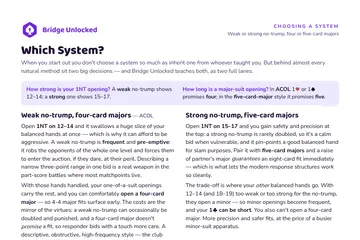
Ring or email first. Most clubs have a beginners’ or “gentle” session, and nearly all will find you a partner if you turn up alone, say so when you book. Ask what system the club mostly plays (in Ireland and the UK it’s usually ACOL) and whether the session is duplicate or rubber.
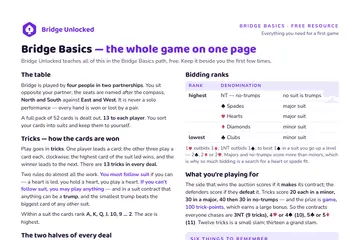
Bring: a pen, your reading glasses, table money, and, if you like, the bidding cheat sheet for your system. It’s handy to run through it with your partner before the game begins. Your phone stays in your bag on silent.
Arrive fifteen minutes early. Sessions start on time because the movement needs every table seated.
What “duplicate” means
At home you shuffle, deal, play and score each hand on its own. At a club the same deals are played by every table, and you are scored against the other pairs who held exactly your cards. Luck of the deal disappears; your bidding and play are what count.
That is why the cards live in boards: holders with four slots marked N, E, S, W. Each board shows its number, the dealer, and the vulnerability.
The director
Every session has a tournament director, not a referee to be feared, but the person who sorts out the small mechanical things that go wrong at every table: a card played out of turn, a bid not high enough, a card that falls face up, a revoke. When something odd happens, stop, don’t try to fix it yourselves, and call “Director, please.” It is completely normal; experienced players call the director more often than beginners, not less.
What happens, in order
- Sit down. You’ll get a pair number and be told whether you are North-South or East-West. N-S usually stay put; E-W move after each round.
- The boards arrive, two or three per round. Take the cards from your slot, count them (thirteen, always count), and sort.
- Bid with the bidding box. Take the card you want and everything under it, and lay it in front of you overlapping left to right. Green is Pass, red Double, blue Redouble. Once your fingers leave the card, the bid stands.
- Alerts. If partner makes a bid with an unusual meaning (in most clubs, Stayman and other conventions), tap the Alert card so the opponents can ask. Ask the club what needs alerting.
- Play, but don’t gather tricks. Play your card face up in front of you, then turn it face down pointing towards the side that won. Your row of cards is the result.
- Agree the result out loud: “four spades making”, “three no-trumps, one down”.
- Record it. North enters the contract, declarer and tricks on the traveller or, in most clubs now, the tablet; East-West check and accept.
- Cards back in the right slot, and no discussion until the round is over: the next table hasn’t played it yet.
- Move when the director calls it. East-West go up a table; boards go the other way. Someone will point.
- Results come at the end as a percentage.
At the table
The housekeeping that keeps a club night running, and the worries every beginner brings, answered.
- Keep the boards on the table, the right way round, to avoid misboarding: very disruptive to the competition, and penalised.
- Keep the bidding cards on the table until the opening lead has been made, face down.
- As declarer, wait until your left-hand opponent has played before playing from dummy: a common discourtesy even among experienced players.
- Shuffle your own cards briefly before returning them to the board.
- Leave your played cards in front of you until both sides have agreed the result.
- Tidy up bidding boxes and other paraphernalia at the end of the night.
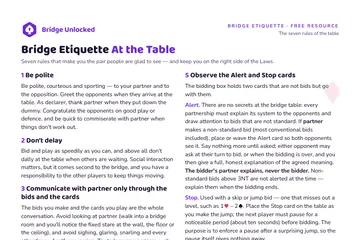
Etiquette: the seven rules, in one breath
- Be polite.
- Don’t delay.
- Talk to partner only through the bids and the cards.
- Don’t hesitate, and ignore partner’s hesitations.
- Use the Alert and Stop cards.
- Lead face down.
- When in doubt, call the Director.
The full version is on the free Bridge Etiquette sheet.
Things beginners worry about, and shouldn’t
“I’ll hold everyone up.” A beginners’ session expects it; in an open session, tell the Director you’re new and you’ll get a gentle seat. Everyone in that room was new once.
“I don’t know the conventions.” If an opponent alerts a bid you don’t understand, ask. That is exactly what the alert is for.
“I’ll make a mistake in the bidding box.” You will, and so will the person across from you. Call the Director; it takes thirty seconds.
“I’ll revoke.” Count to thirteen when you pick up, and check you have none of the suit led before you play another. If it happens, it’s a Director call, not a crime. The app’s What Happens If…? lesson shows what happens next.
This handout goes with the Beginner course, in ACOL or 5-card majors.