A
- Alert card
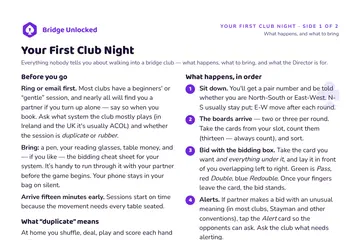
The card you show the opponents when partner’s bid has a special meaning, never for your own bid. They may then ask what it means.
- Attitude signal
When partner leads an honour, the card you play tells them whether to continue: a high card says yes, keep going; a low card says no, try something else.
- Auction
The bidding. Starting with the dealer, each player in turn bids or passes; it ends when three players pass in a row, and the last bid becomes the contract.
B
- Balanced hand
A hand with no singleton, no void and at most one doubleton: 4-3-3-3, 4-4-3-2 or 5-3-3-2. Balanced hands are no-trump hands.
- Bid
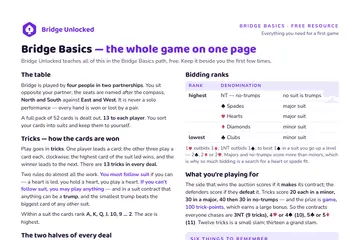
A number and a denomination, one heart, two no-trumps, promising to win that many tricks over six. Each bid must outrank the one before.
- Biddable suit
A suit good enough to bid: any five-card or longer suit, or a four-card suit headed by an ace, king, queen or jack.
- Bidding box
The tray of cards you bid from at a club: the 35 bids plus Pass, Double, Redouble and the Stop and Alert cards. You lay your call on the table instead of saying it.
- Blackwood
The 4NT convention: once trumps are agreed, 4NT asks partner how many aces they hold (5 = 0 or 4, 5 = 1, 5 = 2, 5 = 3). Used to check for slam.
- Board
In duplicate bridge, the plastic or wooden holder the four hands travel in. It shows the dealer and the vulnerability for that deal.
C
- Call
- Anything you say in the auction: a bid, a pass, a double or a redouble.
- Contract
The final bid of the auction: the strain and the number of tricks over six that the winning side has promised to make.
- Cover an honour
Playing a higher honour on an honour led by the opponents, so that both their card and yours are spent on one trick and your lower cards are promoted.
D
- Dealer
- The player who deals the cards and makes the first call of the auction.
- Declarer
The player who plays the hand: the first member of the winning side to name the strain of the final contract. Declarer plays both their own cards and dummy’s.
- Defenders
- The two players trying to defeat the contract.
- Denomination
What a bid names: clubs, diamonds, hearts, spades or no-trumps. Also called the strain.
- Discard
Playing a card of another suit (not a trump) when you cannot follow suit. Your first discard usually says which suit you would like partner to lead.
- Distribution
The number of cards you hold in each suit, written longest first: 5-4-3-1. Also called shape.
- Double
A call that raises the stakes on the opponents’ contract. A take-out double (see below) asks partner to bid; a penalty double says I think they’re going down. At beginner level the double of 1NT is the penalty double.
- Doubleton
- Exactly two cards in a suit.
- Drawing trumps
Leading trumps until the opponents have none left, so they can no longer ruff your winners.
- Ducking
Deliberately losing a trick you could have won, usually to keep an entry or to set up a long suit.
- Dummy
Declarer’s partner. After the opening lead, dummy lays their cards face up and takes no further part in the play.
E
- Entry
A card that lets you win a trick in a particular hand so that you can then lead from it. Managing entries is half of declarer play.
- Establishing a suit
Driving out the opponents’ high cards in a suit so that your remaining cards in it become winners.
F
- Finesse
Trying to win a trick with a card that is not the highest outstanding, by leading towards it and hoping the missing honour sits in front of it rather than behind. Succeeds about half the time.
- Fit
Eight or more cards in one suit between your hand and partner’s. A fit is what makes a suit playable as trumps.
- Follow suit
- Play a card of the suit led. You must, if you can.
- Forcing bid
A bid partner is not allowed to pass. A new suit by an unpassed responder, the 2 opening, and the strong twos are all forcing.
- Fourth-best
The fourth card down from the top of your longest, strongest suit: the usual opening lead against no-trumps.
G
- Game
A contract worth 100 or more trick-points: 3NT, 4, 4, 5 or 5. Bidding and making game earns a large bonus, which is why 25 combined points is the number every auction is trying to find.
- Grand slam
A contract for all thirteen tricks (7 to 7NT).
H
- HCP, high card points
- Ace 4, king 3, queen 2, jack 1. Forty in the pack; twelve opens the bidding.
- Hold-up
Refusing to win a trick in the opponents’ suit straight away, so that one defender runs out of it before their partner can get in.
- Honour
- An ace, king, queen, jack or ten.
I
- Invitational bid
A bid that says bid game if you’re better than minimum, otherwise pass: 2NT over 1NT, or a jump raise of partner’s suit.
J
- Jump bid
A bid one level higher than necessary: 1-3 instead of 1-2. A jump shows extra strength.
- Jump overcall
At beginner level, a strong jump in a new suit over the opponents’ opening: 15-16 with a good six-card suit. From the Improver level onward it turns weak, so if a club opponent jump-overcalls, ask which they play.
- Jump shift
A new suit bid one level higher than needed (1-1-3). As opener’s rebid it shows 19 or more and forces to game.
L
- Lead
The first card played to a trick. The opening lead is the first card of the whole hand, made by the defender on declarer’s left.
- Length points
One extra point for every card beyond four in the agreed trump suit; counted only once you have a fit.
- LHO / RHO
- Your left-hand and right-hand opponents.
- Limit bid
A bid with a narrow, defined range that partner can pass: 1NT, a raise, a no-trump response. It says this is all I have.
- Loser
A trick you expect to lose. In a suit contract, count the losers in your own hand, suit by suit, among the top three cards.
M
- Major suits
- Spades and hearts. They score 30 a trick, so game is ten tricks.
- Minor suits
- Diamonds and clubs. They score 20 a trick, so game is eleven tricks.
N
- No-trumps (NT)
- A contract with no trump suit at all: the highest card of the suit led always wins.
O
- Opening bid
- The first bid of the auction. It needs 12 or more points.
- Overcall
A bid made after the opponents have opened. At the one level it promises 8-16 points and always a five-card or longer suit.
- Overtrick
- A trick made beyond the number the contract promised.
P
- Part-score
- Any contract below game.
- Pass
- No bid. Three passes in a row end the auction.
- Penalty pass
Passing partner’s take-out double when you have length in their suit, so it becomes a penalty double and you defend.
- Playing tricks
The tricks a hand can be expected to win on its own, counting long suits and top cards rather than points. The strong two openings are measured in playing tricks (about eight).
- Prepared bid
In ACOL, an opening of 1 or 1 on only three cards, made because the hand is balanced but too strong for 1NT and has no four-card suit worth bidding.
R
- Raise
Bidding partner’s suit at a higher level to show support for it: the single raise, the jump raise and the game raise show rising strength.
- Rebid
Opener’s second bid, which describes the hand further after partner has responded.
- Redouble
After the opponents double, a call that doubles the stakes again. Also used to show a good hand with no fit for partner.
- Response
- Partner’s first bid after the opening bid.
- Reverse
Opener rebidding a new suit at the two level that outranks the first suit (1 then 2). It promises 16+ points, because a partner who prefers your first suit has to go back to it at the three level.
- Ruff
- To play a trump on a trick when you cannot follow suit. Also called trumping.
S
- Second hand low
The defenders’ guideline for the player who plays second to a trick: play low and let partner, who plays last, do the work.
- Sequence
Touching honours in one suit: K-Q-J, Q-J-10. Leading the top of a sequence is the classic safe lead.
- Shortage points
Extra points for a doubleton (1), singleton (2) or void (3) in a side suit, counted only when you hold support for partner’s suit.
- Singleton
- Exactly one card in a suit.
- Slam
A contract for twelve tricks (small slam) or thirteen (grand slam). Around 33 combined points for a small slam, 37 for a grand.
- Stayman
The 2 response to 1NT that asks do you have a four-card major? Opener answers 2 (no), 2 or 2 (yes, that one).
- Stop card
Shown before a jump bid (one that skips a level). The next player waits about ten seconds before calling.
- Stopper
A card or holding that will win a trick in the opponents’ suit, so they cannot run it against you in no-trumps.
- Strong two
An opening of 2, 2 or 2 showing about eight playing tricks in a long strong suit. Forcing for one round; partner’s weak reply is 2NT. (Improver players replace these with weak twos, the meaning changes with the level.)
- Support
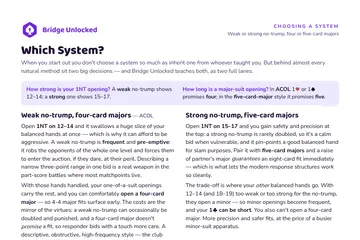
Cards in partner’s suit. Four is the usual requirement to raise; in the five-card-major system three is enough to raise a major.
T
- Take-out double
A double of the opponents’ opening bid that asks partner to bid their best suit. It shows opening values, shortage in their suit and support for the other suits. Partner must respond, even with nothing.
- Third hand high
The defenders’ guideline for the player who plays third to a trick: play your highest card to try to win it, or to force out declarer’s honour.
- Trick
- Four cards, one from each player. Thirteen in every deal.
- Trump
The suit named in a suit contract. Any trump beats any card of another suit.
- Two-club opening (2)
The strongest opening bid: 23+ balanced, or eight-plus playing tricks. Artificial (nothing to do with clubs) and forcing to game: only 2-2-2NT may be passed. Partner’s weak reply is 2.
U
- Unbalanced hand
- Any hand that is not balanced: it has a singleton, a void, or two doubletons.
- Unblocking
Playing your high cards from the shorter holding first, so that the suit can be run from the hand with the length.
- Undertrick
Each trick by which a contract falls short. The defenders score for them.
V
- Void
- No cards at all in a suit.
- Vulnerable
A state in which the bonuses for making game are larger and the penalties for going down are heavier. In duplicate it is set by the board; in rubber bridge you become vulnerable by winning a game.
W
- Weak take-out
A response of 2, 2 or 2 to 1NT with a weak hand and a five-card suit: let’s play here, partner, pass. (At Improver level the same bids become transfers, and the meaning changes.)
- Winner
A card that is certain to win a trick. Counting your winners is the first step in planning a no-trump contract; counting your losers, the first step in a suit contract.
Y
- Yarborough
A hand with no card higher than a nine: no aces, kings, queens, jacks or tens.
Every term here is tap-to-explain inside Bridge Unlocked, where the full glossary grows with you through Improver and Advanced.
You can also look terms up in the bridge glossary on this website.
This handout goes with the Beginner course, in ACOL or 5-card majors.