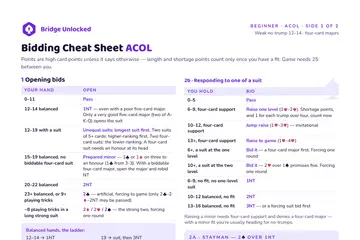
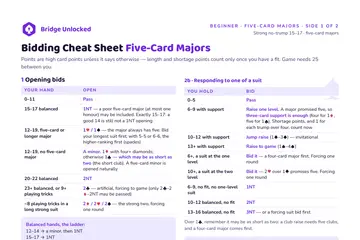
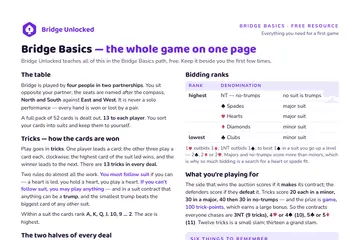
Before you can bid, you need to know what your hand is worth. High card points first, every hand. Shape, length and shortage, only counts once you have found a fit.
1. High card points, count these first
| Card | Points |
|---|---|
| Ace | 4 |
| King | 3 |
| Queen | 2 |
| Jack | 1 |
Ten in each suit, 40 in the pack; a dead-average hand is 10. 12 is where an opening bid begins. Tens count nothing, but a ten sitting with other honours (A-J-10, K-Q-10) makes a suit noticeably better.
2. Length points, only with a trump fit
| Trumps held | Add |
|---|---|
| 5 cards | +1 |
| 6 cards | +2 |
| 7 cards | +3 |
Extra trumps win extra tricks. Count length only in the agreed trump suit, once you have found a fit, never in a side suit, and never before the fit.
3. Shortage points, only with a trump fit
| Holding | Add |
|---|---|
| Doubleton (two cards) | +1 |
| Singleton (one card) | +2 |
| Void (none) | +3 |
A short suit is worth something only because your trumps can ruff it, so count shortages only when you hold support for partner’s suit, in the other suits. Never for a no-trump contract.
4. Balanced or not?
Your shape is the number of cards in each suit, longest first: 4-4-3-2, 5-3-3-1. A hand is balanced if it is 4-3-3-3, 4-4-3-2 or 5-3-3-2: no singleton, no void, at most one doubleton. Balanced hands are no-trump hands; everything else wants a trump suit.
5. What the total buys you
| Combined points | Expect to make |
|---|---|
| 20-24 | A part-score, 7 to 9 tricks |
| 25-32 | Game: 3NT, 4 / 4, 5 / 5 |
| 33-36 | A small slam, 12 tricks |
| 37+ | A grand slam, 13 tricks |
Add your points to what partner’s bids have promised. Most bidding decisions come down to one sum: can we reach 25?
6. Three hands, counted
K J 8 4 · A 7 3 · Q 10 6 2 · 9 5
3+1+4+2 = 10 HCP, balanced (4-4-3-2). Not an opening bid. If partner opens, you have a raise or a no-trump response.
A Q 9 7 5 2 · K 4 · 8 · K J 6 3
4+2+3+3+1 = 13 HCP: an opening bid, and spades is the suit to show. When partner supports spades you have a fit, so add 2 for the six-card spades = 15.
6 · Q 9 6 4 · A 8 5 3 · K 7 4 2
Partner opened 1. 9 HCP, and with four-card heart support add 2 for the singleton spade = 11, the difference between a single raise and a jump raise.
This handout goes with the Beginner course, in ACOL or 5-card majors.